Investment diversification made simple: spreading risk, protecting wealth

Table of contents
This article explains what investment diversification means, how it helps mitigate risk, and how you can structure your portfolio intelligently.
Volatile markets, geopolitical crises, and uncertain forecasts make investing increasingly complex. Many investors wonder how to safeguard their assets in such uncertain times. Diversification is considered a key strategy for spreading risk and achieving more stable long-term returns.
What does investment diversification mean?
At its core, investment diversification means spreading risk. Instead of putting all your money into a single investment, it is distributed across different asset classes, industries, or projects.
In simple terms: Diversifying your investments makes you less dependent on the performance of individual markets.
A well-known example is ETFs (exchange-traded funds). A broadly diversified ETF invests not in a single company but in many different stocks simultaneously. This principle can be applied to other forms of investment as well.
Typical strategies for diversifying investments:
- combining different asset classes
- spreading investments across various industries
- utilizing different investment durations
- including multiple projects or providers
How useful is investment diversification?
EThere is no such thing as a portfolio perfectly prepared for every possible market scenario — not for professionals, nor for private investors. Still, risk can be significantly reduced by consciously spreading assets.
In short: diversification doesn’t eliminate risk, but it distributes it more effectively.
Investors who hold only individual stocks feel market fluctuations more intensely. It’s a different story when investments are spread broadly — for example, across stocks, ETFs, fixed-income products, or business equity. If one segment underperforms, others can help stabilize the portfolio.
Common benefits of a well-diversified investment:
- reduced dependence on specific markets or companies
- less volatility from market fluctuations
- better balance between risk and return
Investment diversification helps soften the impact of market swings. While it doesn’t provide absolute safety, it supports a more balanced and long-term approach to managing wealth.
Return and safety: a realistic perspective
Many investors desire high returns with minimal risk. In practice, however, these two goals usually contradict each other. High return potential almost always comes with higher risks.
Takeaway: The higher the return, the greater the risk — generally speaking.
Investment diversification helps find a sensible middle ground. It doesn’t replace risk or return — it ensures both are in a healthy proportion, and that investment decisions aren’t driven by individual market events.
Saving and safety in investing
Many potential investors never take the step toward becoming active investors because they want to avoid any kind of risk. Instead of investing, they leave their money in a savings account or place it in fixed or overnight deposit accounts.
This hesitation is understandable. Deposits in traditional savings accounts are protected by statutory deposit insurance up to €100,000 per person and per institution. For many, safety is the top priority.
However, these forms of saving don’t have to be excluded — quite the opposite. Financial experts even recommend always keeping a financial buffer.
General rule of thumb:
- two to three months’ salary in a checking or savings account
- funds should be readily available for unexpected expenses like car repairs or a new washing machine
Only beyond that does investment diversification become relevant. The capital that can be spared long-term — for wealth accumulation or retirement planning — should be considered for diversified investment. This way, day-to-day security and long-term market opportunities can be meaningfully combined.
How can investors diversify their assets?
Every investment diversification starts with a fundamental question: What do I want to achieve with my money, and how much time do I have?
Whether small amounts are invested regularly or a larger sum is available at once doesn’t matter initially. What counts is a balanced investment structure that matches personal goals and time horizon.
Which asset classes are available?
To achieve broad diversification, a combination of different investment types can be used, for example:
- bank deposits: savings accounts, overnight and fixed-term deposits
- stocks
- investment funds and ETFs: equity funds, bond funds, mixed funds, index funds
- bonds: fixed-income securities, government and corporate bonds
- commodities and precious metals, e.g., gold
- real estate: direct investments or real estate funds
- equity investments and tangible assets
- crowdlending and crowdinvesting: investments in personal or business loans, and real estate projects
- cryptocurrencies
Not every investment type suits every individual. The right mix is what matters.
The 3-step rule of thumb for investment diversification
A proven model for structuring investments follows the logic of three levels:
- security and liquidity as a base
Secure, readily available deposits form the foundation of your assets, such as overnight or fixed-term accounts. They serve as a financial buffer. - stable wealth building
For medium- to long-term goals, investment types that generate returns with moderate volatility are added — for example, ETFs, investment funds, bonds, or real estate funds. - targeted use of return opportunities
Higher-risk, higher-reward investments can be included to increase overall returns — such as stocks, commodities, equity stakes, crowdinvesting, or cryptocurrencies.
key takeaway: not every asset must deliver maximum return. The interaction of components is what matters most.
Infobox: the 10×10 rule for crowdinvesting
In crowdinvesting, diversification is especially important since individual projects can perform very differently. The 10×10 rule clearly illustrates how to spread risk effectively.
Comparison:
❌ investing €10,000 in a single project
✅ spreading €1,000 across ten different projects
Example:
An investor puts €1,000 each into ten different crowdinvesting projects — across various industries, countries, or durations. If one project underperforms, it affects only a small portion of the total portfolio. The remaining investments can compensate for the weakness.
Why this principle is effective for crowdinvesting:
- lower individual risk: the failure of one project doesn’t jeopardize the entire investment
- flexibility: it works even with smaller amounts
- more stability: different projects respond differently to market changes
Good to know:
The actual number of projects depends on your personal budget and risk appetite. What matters is not the exact number — but the principle behind it: diversification creates stability.
Important: diversify within asset classes too
Investment diversification is about more than just selecting different types of assets. It also includes:
- spreading across regions (e.g., Europe, USA, emerging markets)
- spreading across industries (e.g., manufacturing, services, technology, real estate)
This helps prevent any single economic development from having an outsized impact on your entire portfolio.

For all investment types, assets should also be selected across different regions (e.g., Europe, USA, emerging markets) and industries (e.g., manufacturing, services, technology, real estate).
Avoiding concentration risk in investment diversification
Concentration risk arises when a large portion of your capital is tied up in one investment or a few similar ones. This can quickly become problematic — even if the investment seems “safe” at first glance.
A common example is over-concentration in real estate. A self-used property is usually unproblematic, as it replaces ongoing rent payments. However, things change when real estate is held purely as an investment.
Potential risks of rental properties:
- administrative efforts and ongoing costs
- vacancies and rental defaults
- maintenance and renovation expenses
Investors who allocate all their capital to this area become overly dependent on a single market. Alternatives include partial investments via open-ended real estate funds or shares in real estate companies — these are more diversified and easier to sell.
Other examples of concentration risk
Concentration risks don’t only arise with real estate. Other common scenarios include:
- investing solely in the stock of a single company
- buying government bonds from only one country
- focusing exclusively on gold as a crisis hedge
Events like the emissions scandal in the auto industry or structural shifts in the energy sector show how heavily certain companies or sectors can come under pressure. This doesn’t mean equity investments should be avoided — but it does highlight the need for broader diversification within a sector.
Even spreading investments across multiple companies could have led to significantly better diversification.
Also with bonds: balancing safety and return
ÄhThe same applies to government bonds. Investors who choose only highly secure bonds face minimal default risk — but often miss out on substantial returns. Bonds with higher yields from emerging markets offer more return but also more volatility.
The solution lies in a mix:
- a stable portion of safe bonds to preserve capital
- a targeted allocation of higher-yield investments to create opportunities
This keeps the portfolio balanced and resilient.
Examples of meaningful portfolio diversification
There are many sample portfolios that can serve as guidance for investors. However, they are no substitute for an individual investment strategy. Personal factors such as age, life situation, financial goals, and risk tolerance always play a decisive role.
Generally, two main investment goals can be distinguished:
- wealth accumulation with a willingness to take controlled risks
- wealth preservation and inflation protection with lower volatility
A commonly mentioned example is an evenly balanced portfolio, for instance:
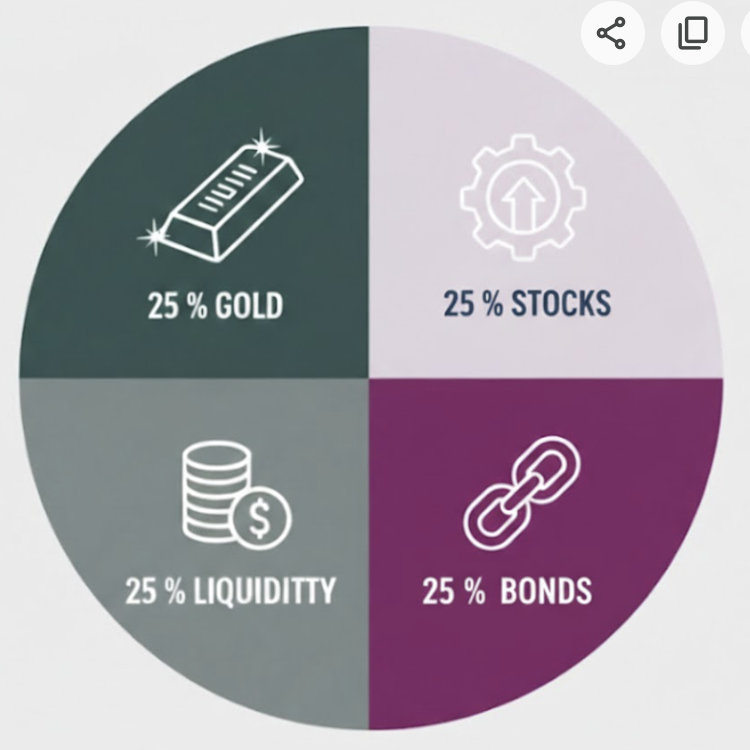
-> 25% stocks, 25% bonds, 25% liquidity, 25% gold
Here, gold often serves as a hedge against extreme crisis scenarios. Whether this allocation is suitable depends heavily on one’s personal situation. It serves as an orientation — not a universal solution.
„Diversification is protection against ignorance. It makes little sense for those who know what they’re doing.“ (Warren Buffett )
How to keep track of your investment diversification
Diversification doesn’t end with stocks, bonds, or ETFs. Many investors gradually expand their portfolios with additional assets such as real estate, commodities, or crowdinvesting.
Depending on life stage, the allocation may vary. Younger investors often lean more heavily toward stocks, while precious metals play a lesser role. Government- or employer-sponsored retirement options can also be worthwhile — especially due to potential subsidies or tax advantages.
Important to note:
A self-used property primarily serves as personal security. It counts as part of overall wealth but usually isn’t considered a classic investment within a diversified portfolio.
Practical tip:
To stay on top of things, all assets should be regularly summarized in a comprehensive overview. Only those who understand the full picture of their financial situation can manage their diversification effectively.
Why diversification makes sense in investing
A well-diversified asset structure reduces the total risk of invested capital. Losses in individual assets are less significant because other portfolio components can help offset them.
At the same time, a broadly diversified portfolio often offers better return potential than purely safe investment types like savings or term deposits. Diversification balances stability and growth opportunities.
Even well-informed investors can’t foresee all risks and details of specific investments.
Key Takeaways on Investment Diversification
 Diversification means spreading risk instead of relying on a single investment
Thoughtful diversification reduces volatility but doesn’t replace risk or return
Different asset classes, regions, and durations increase portfolio stability
Concentration risks arise when too much is invested in individual projects, sectors, or countries
In crowdinvesting, the 10×10 rule helps spreading individual risks effectively
Get even more tips and knowledge
Directly to your mailbox
Subscribe to tips & make better investment decisions